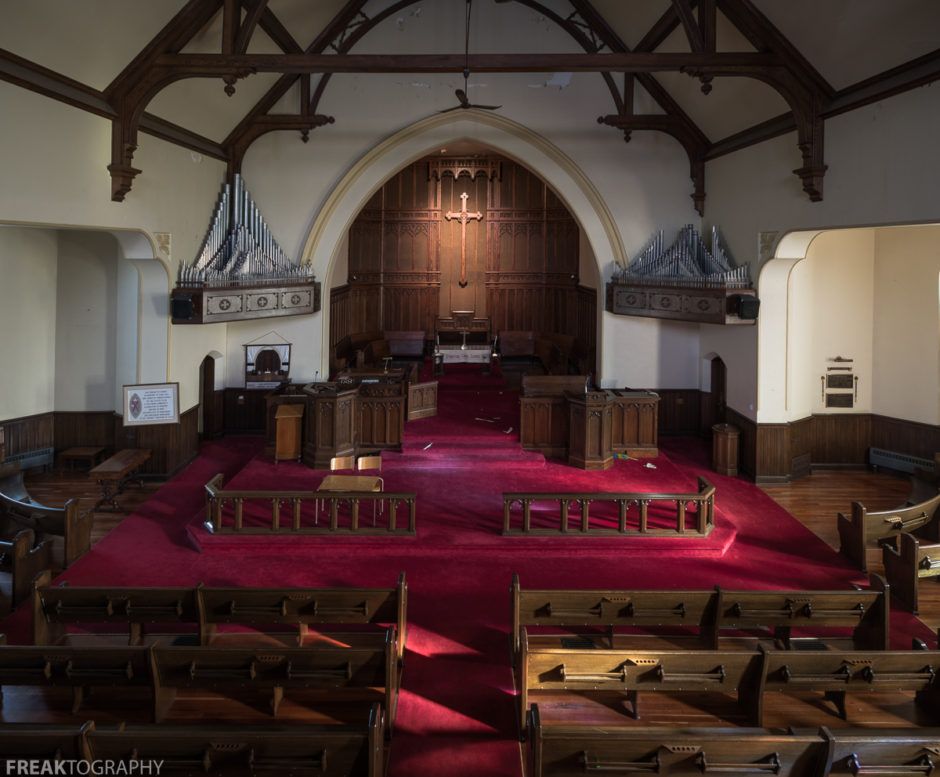

The purpose of this post is to reveal how the United Church of Canada has left the true gospel and will be revealing the reasons for the massive decline in a once large and thriving church.
When a church replaces biblical authority with cultural approval, it eventually loses both its message and its reason to exist.
Biblical Authority Quietly Gives Way to Cultural Approval and Social Activism
“A Lighthouse That Forgot Why It Exists”
This analogy helps to demonstrate the turning away from the truth….
Imagine with me a lighthouse that replaces its fixed light with crowd-controlled colors.
Keep in mind that a lighthouse exists for one reason: to guide ships safely through dangerous waters.
Its light is fixed, steady, and non-negotiable. Why? Because the rocks don’t move.
Now imagine this:
The lighthouse keepers decide the light feels too harsh.
Some sailors complain it’s offensive, outdated, or exclusionary.
For this reason…. the keepers begin adjusting the light:
- softer tones
- shifting colors
- eventually letting passing ships vote on what the light should be.
At first all seems great!
The lighthouse becomes very popular.
Everyone feels seen.
But it must be remembered – the rocks are still there.

Soon ships begin to wreck—not because the keepers were unkind, but because a lighthouse that follows ships – instead of guiding them – stops being a lighthouse.
Eventually, sailors stop looking to it at all.
Do you recognize how this analogy maps?
- The light is God’s Word; it is fixed, it reveals reality.
- The rocks are sin, judgment and spiritual danger.
- The ships are the people that the church is meant to serve.
- Changing the light is replacing biblical authority, the Light of God’s word with cultural approval.
- Shipwrecks describe spiritual confusion, loss of repentance and loss of personal salvation focus.
- Abandonment is the result; church decline and irrelevance.
The tragedy isn’t that the church wanted to be loving.
It’s important to realize that the tragedy is that love without truth (truth which is found in the inspired word of God, the Bible) leaves people blind and in real danger!
Revealing the Reasons: Examining the UCC statement of faith
Let’s have a look at some of their beliefs directly from their Statement of Faith and how they depart from biblical truth.
The church’s faith is grounded in truths that are timeless. These truths, however, must be embraced anew by Christians of each generation and stated “in terms of the thoughts of their own age and with the emphasis their age needs” (Statement of Faith, 1940).
Generally speaking, the opening sentence sounds good,
The church’s faith is grounded in truths that are timeless.
However, the word “truths” is not defined.
The next sentence reads –
These truths, however, must be embraced anew by Christians of each generation and stated “in terms of the thoughts of their own age and with the emphasis their age needs.”
Notably, this is a key shift stating that truth is not simply received and preserved but it must be re-appropriated and re-experienced implying that faith is experiential and contextual; meaning that doctrine lives in experience, not primarily in theory; therefore, authority shifts from the text to the interpreting community.
The church then, becomes an ongoing interpreter rather than a custodian of settled meaning.
This allows for modern philosophies, social theories, and moral frameworks to become legitimate tools for re-stating doctrine.
Consequently, biblical language may be judged “outdated” and new categories may replace old ones.
What does that mean?
It means that the underlying way reality is understood shifts, and when that happens the doctrine itself changes even if familiar words remain.
Importantly, this is not just simple re-wording like using modern English instead of biblical English. It’s not about vocabulary, it’s about the conceptual framework.
Revealing the reasons: Translation of words versus Replacing meaning of words
Translation of biblical words is not new – there are various very good Bible translations available that retain the biblical meaning of words in the original language.
The problem arises when – instead of accurate translation – there is a replacement of words which creates a key shift from biblical truth.
- What the United Church statement is saying theologically
The statement of faith reflects core convictions of the UCC as articulated especially in A Song of Faith.
Their statement of faith acknowledges that the church has “not always lived up to its vision” and challenges it “to live by grace rather than entitlement.” It calls the church to a mission of solidarity, standing with the oppressed, offering resistance to “forces that exploit and marginalize.” And it affirms that the Spirit is active not only in Christian community but also “in the world.”
There are five statements in the UCC statement of faith that will be analyzed below that point out the “key shift”.
1. Confession of failure:
“The church has not always lived up to its vision. “Historically, this is a confessional move. The church acknowledges moral failure, complicity in injustice and distance between calling and practice. These statements echo biblical laments as in Daniel 9 and Nehemiah 9 that are acknowledgements of their rebellion and sin against God but – the UCC frames it corporately and institutionally, not primarily in terms of sin against God, but failure to embody a vision of justice and grace.
Key shift:
The failure of the UCC is ethical and social more than doctrinal or spiritual.
2. Grace rather than entitlement:
“Challenges it to live by grace rather than entitlement”
This reframes the biblical meaning of grace as a posture of humility; a rejection of moral or spiritual privilege; resistance to institutional self-protection.
Key Shift:
Biblically, grace answers human guilt before a Holy God. It is the freely given, unmerited favor, love and kindness of God toward humanity. Ephesians 2:8,9
However, in their statement, “Grace rather than entitlement” grace is used more as a way of behaving; a check against arrogance and a call to institutional humility.
Grace in understood in this statement more as giving up power and privilege, rather than as God forgiving sinners.
3. Solidarity with the oppressed:
“Calls the church to admission of solidarity, standing with the oppressed.“
This statement draws strongly from Liberation theology; contextual theology and social gospel traditions.
Salvation is expressed as alignment: Instead of focusing on belief or forgiveness, salvation is seen as showing up for people in pain and sharing in their struggles.
Key Shift:
The church is made credible not by the preservation of doctrine or power, but by its ethical commitment to stand in solidarity with the marginalized and to resist forces that exploit and exclude.
4. Resistance to exploitative forces:
Offering resistance to forces that exploit and marginalize.
Here evil is framed primarily as; structural, systemic and economic and political.
Key Shift:
Sin is not denied but redefined so that it is less about rebellion against God and more about participation in unjust systems.
The church becomes a resistance community, with mission defined as social transformation rather than personal transformation.
5. The Spirit active beyond the church
Affirms that the Spirit is active not only in the Christian community but also in the world.
The statement implies that Christianity is one participant in a broader divine movement.
The following is a quote from APPENDIX C –On the Context of the Statement of Faith
While believing that its faith is grounded in truth, the church strives to understand that its truth need not deny the truths of others.
It would seem that they do not take Jesus’ words from John 14:6 literally when he said:
“I am the way and the truth and the life. No one comes to the Father except through me.”
It is true that the Holy Spirit is involved in convicting all people of sin. John 16:8,9 and the Spirit also testifies of Christ who points people to the Lord Jesus. John 15:26
However, the Holy Spirit indwells only those who have believed in and accepted Jesus’ gift of salvation through His atoning blood. Romans 8:9; 1 Corinthians 12:13
In the UCC statement of faith – A Song of Faith – truth is encountered, not possessed.
Summary comparison of word meanings in Historic Christian Faith and United Church Statement
Aspect
Historic Christian Faith
United Church Statement
Core Issue
Grace
Salvation
Church
Holy Spirit
Sin before God
Forgiveness & Justification
Reconciliation with God
Teach Biblical doctrine, Share the gospel
Lives in believers, convicts people of sin
Injustice & brokenness
Humility and de-centering
Social healing & justice
Participant in liberation
Active throughout the world
Intentions for the shift in word meanings may be well-intended but they depart from biblical meaning. These shifts in belief even sound righteous to many people. The bible predicts a time such as the time we now live in.
For a time is coming when people will no longer listen to sound and wholesome teaching. They will follow their own desires and will look for teachers who will tell them whatever their itching ears want to hear. They will reject truth and chase after myths. 2 Timothy 4:3,4
Beliefs such as:
- the need to reinterpret scripture to accommodate what they consider new knowledge; 1 Thessalonians 2:13; 2 Peter 1:21; 2 Timothy 3:16
- the belief that love requires affirming people as they are – even in their practice of sin;
- justice is the heart of the gospel rather than repentance and forgiveness of sin through Jesus substitutionary death and resurrection. Luke 24:46,47
Sadly, biblical passages that challenge our current cultural values are redefined, minimized, labeled contextual or treated as harmful.
At that point, culture becomes the final authority, not Christ.
Response to affirming people in sin–
- It is not loving to allow a person to remain stuck in sin.
- It is not hateful to tell a person he or she is in sin.
- In fact, the exact opposites are true. Sin leads to death. James 1:15, and
- We love the sinner by speaking the truth in love. Ephesians 4:15
- We hate the sin by refusing to condone it, ignore, or excuse it.
Jesus comes full of grace and truth – never one without the other. John 1:14
Revealing the reasons: The UCC has lost biblical authority
This video 2 Million Gone, describes what is happening to the United Church of Canada. It has been declining steadily since it turned away from core aspects of the Historic Christian Faith to become more relevant with our current culture. The church has lost over 2 million members in two generations. Why?
In the 1960s, the church adopted increasingly progressive, theological and social positions, such as ordaining LGBTQ+ individuals, blessing same-sex unions, emphasizing social justice over doctrinal boundaries.
They hoped to attract new secular Canadians.

However, this failed as secular younger generations saw no compelling reason for religious participation as secular institutions already offered similar values – without a religious framework.
The result has been shrinking congregations that has led to financial and demographic decline.
It appears that the gospel that Jesus taught, that we are all sinners in need of a Savior is no longer their reason for existence.
The United Church largely ceased focussing on an evangelism view, viewing it as inappropriate. Why you might ask…
Because:

Evangelical Christians say their beliefs, founded in the authority of the holy bible, are the only true way; that there is only one way to salvation – through Jesus Christ, the perfect sacrifice who died to redeem sinners, while the United Church of Canada has moved away from that view.
Classic Christian evangelism believes:
- Christianity uniquely possesses saving truth
- Other religions are deficient or false
- People need to be converted to Christ to be reconciled to God
The United Church, however, holds that:
- God is Mystery, exceeding all human formulation
- No single tradition possesses absolute truth
- God is active in other faiths and worldviews
Because of this, evangelism aimed at conversion can be seen as:
- Theologically arrogant
- Inconsistent with humility before mystery
- A denial of God’s presence outside Christianity
Warning to the church to remain faithful to the teachings of Jesus!
Subsequently, what is happening in the United Church of Canada should serve as a warning to other churches. We must remain faithful to the Word of God and not change what its message to mankind is. Otherwise, it will have no power, no growth in Christ; what it will have is dead religiosity.
Every good and perfect gift is from above, coming down from the Father of the heavenly lights, who does not change like shifting shadows. James 1:17
I the LORD do not change. Malachi 3:6
The following section is text taken from The United Church of Canada’s statement of faith document:
Some qualities, however, make the United Church distinctive and are significant aspects of its self-identification. One could safely describe the metaphorical “head, heart, and guts” of the United Church’s sense of itself as, respectively: its approach to the interpretation of scripture, its affection for the concept of inclusivity, and its passion for social justice. (Emphasis added)
There is no mention of the mission that Christ commanded in his final words, prior to His ascension into heaven, to His disciples in this statement:
“Go into all the world and preach the gospel to everyone, everywhere” Mark 16:15
Jesus said to Simon Peter and Andrew, Follow me and I will make you fishers of men. Matthew 4:19
The United Church, in its use of scripture, exhibits an approach that “seeks to take the Bible seriously, but not literally.” (UCC statement of Faith -Appendix C- The question of truth)
Over the years the United Church has become increasingly able to embrace diversity while still affirming a sense of distinctive significance that unites us as a faith community. While believing that its faith is grounded in truth, the church strives to understand that its truth need not deny the truths of others.
The statement of faith begins by acknowledging God as “Mystery,” which throws into question any human claims to absolute truth.(Bolded sections-emphasis added)
What these statements explicitly challenge:
- Challenges the fact that scripture gives clear, final, objective truth. 2 Timothy 3:16,17
- Challenges the Bible’s claim that there is only one path to eternal life with God and claims that other religious truths can exist. Christianity is one true path among others.
- Challenges Jesus’ claim that there is only one way to be reconciled to God. John 14:6; John 3:5
In other words, it questions whether any human explanation of faith can be called absolute.
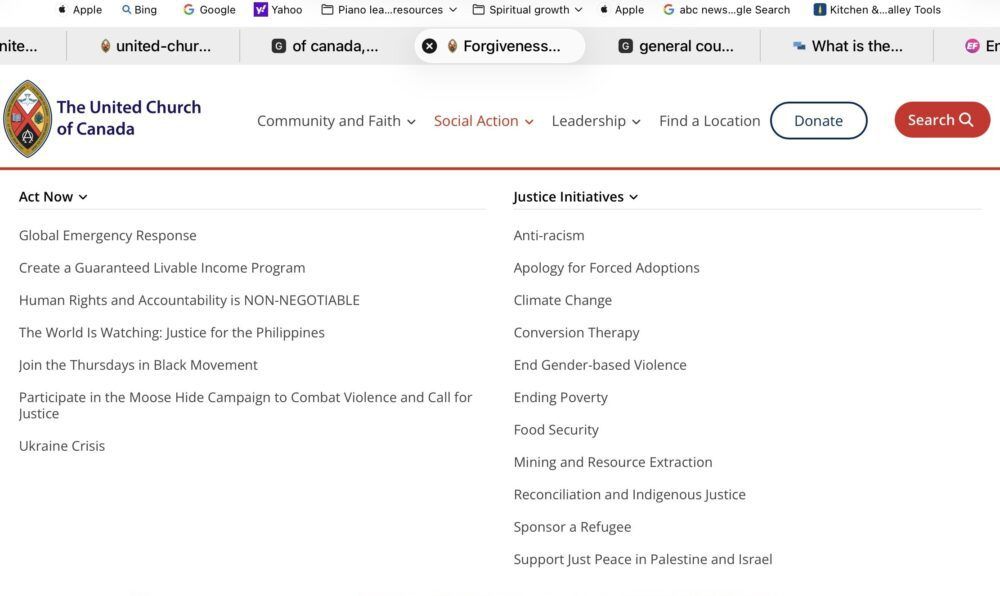
What is the Social Gospel?
The image below shows many of the social initiatives of the United Church of Canada.

The social gospel is reduced to ethics
Social justice, care for the poor, and compassion are biblical fruits, but they are not the gospel itself.
When the church leads with:
- justice instead of justification,
- inclusion instead of repentance,
- activism instead of pursuing personal transformation through Jesus Christ,
the message subtly becomes: “The world needs fixing more than hearts need saving.”
So, the cross fades; the resurrection becomes symbolic; eternal life is rarely mentioned.
Outcomes of Social gospel teaching
The church starts to hollow out
This isn’t just theory—you can see it historically and statistically.
Churches that abandon core doctrines tend to experience:
- sharp membership decline
- aging congregations
- loss of evangelism
- internal fragmentation (because culture never stops shifting)
Why? Because people don’t need the church to tell them what culture already says.
If the church sounds like the world, people choose the world—without the hymns and committee meetings.
Inclusion without truth ultimately excludes
Ironically, churches that pride themselves on radical inclusion often become:
- intolerant of dissent
- hostile to orthodox believers
- unwilling to allow biblical disagreement
Those who hold historic Christian teaching are labeled:
- unloving
- harmful
- regressive
So the church becomes inclusive of everything except biblical Christianity itself.
What the Bible consistently teaches
From Genesis to Revelation, God’s people are called to these and many more:
- love the sinner
- repent from sin, obey God
- resist conformity to the world
- be transformed by the power of the Holy Spirit
- speak truth even when costly
- trust God’s Word over popular opinion
Jesus welcomed everyone—but He never affirmed sin. He said, “Come to me,” and also, “Go and sin no more.”
Grace without truth isn’t grace.
Truth without grace isn’t Christlike.
Biblical Christianity holds both.
The tragic irony
Most churches that make this shift genuinely want to be loving, relevant, and compassionate.
But by abandoning the authority of Scripture, they lose the very thing that makes the church:
- distinctive
- prophetic
- saving
What remains is often a religious NGO with a cross-shaped logo.
Author
-
View all posts
I am passionate about strengthening relationships of all kinds. I love to research and write about how we can live in peace, with patience, passion and purpose in our relationships. The most important relationship being with Jesus who died to provide forgiveness of sin for all who will come to Him.
