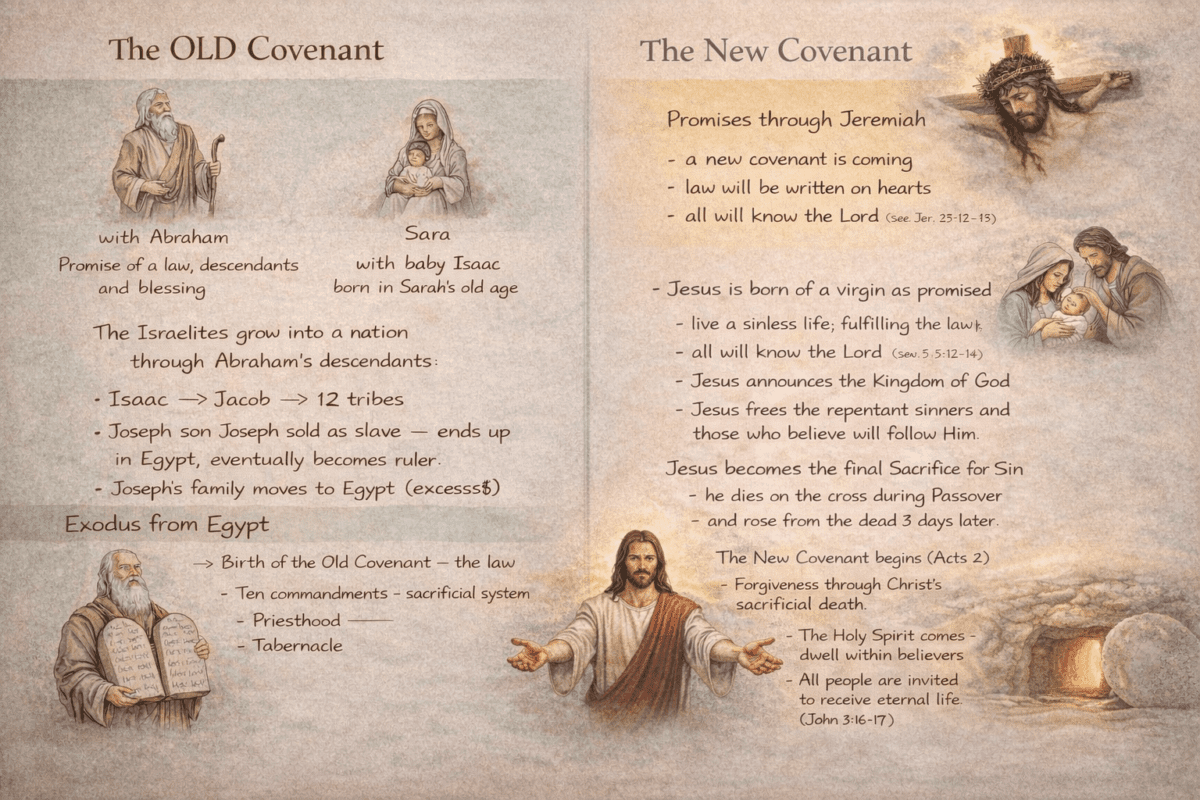
The New Covenant was promised in the Old Testament (Jeremiah 31:31–34) and fulfilled through Jesus Christ.
The Old Covenant and the New Covenant are deeply connected—they are two related systems – one continuous story of God’s relationship with humanity, reaching its fulfillment in Jesus Christ.
Here’s how the Old Covenant came to be and how the New Covenant was promised….
The Old Covenant is instituted.
In Genesis 12:1-3, we read that God called Abram (later called Abraham) and made some promises to him. This was the inauguration of the Old Covenant and it was later expanded through Moses.
In this Covenant, God promised Abram:
- the change of his name to Abraham (father of many nations)
- numerous descendants representing many nations,
- that he would become a great nation,
- blessings on him, and that his name would be great
- He would always be Abraham’s God and the God of his descendants forever.
- to give his descendants the land of Cannan. Genesis 15; Genesis 17.
The sign of this covenant was circumcision, as stated in Genesis 17:10-11:
“This is My covenant with you and your descendants after you, which you are to keep: Every male among you must be circumcised.”
Abraham & Sarah finally have the promised child through whom their descendants would become numerous.
Abraham and Sarah were in their old age and well past child-bearing years when their promised child Isaac was finally born. This is the child through whom the promise of many descendants would be fulfilled.
The article “What is the Abrahamic Covenant?” provides this description of the event:
It is significant that the promise was given to an aged, childless couple. But Abraham “did not waver through unbelief” (Romans 4:20), and his wife Sarah “considered him faithful who had made the promise” (Hebrews 11:11). Abraham was justified by his faith (Genesis 15:6), and he and his wife welcomed Isaac, the son of promise, into their home when they were 100 and 90 years old, respectively (Genesis 21:5).
Abraham's son Isaac's role in the covenant to Abraham.
Abraham sent his servant to find a wife for his son Isaac from among his extended family. The servant found Rebekah, described as a beautiful, hospitable, kind and courageous woman who willingly left her home to marry Isaac.
But, Rebekah was barren for 20 years until Isaac prayed earnestly for God to bless her with children and she gave birth to twins Esau and Jacob.
Jacob, the younger son ended up with the birthright according to God’s intended plan.
Jacob's son, Joseph's role in the story of the Covenant to Abraham.
The first four of Jacob’s children were born to his wife Leah, and she later bore him two more sons and a daughter—seven children total.
The last two of Jacob’s children, Joseph and Benjamin were born to his wife Rachel who died giving birth to Benjamin.
In between were two sons of Bilhah (Rachel’s maid) and two sons of Zilpah (Leah’s maid).
Altogether, Jacob had thirteen children, twelve sons and one daughter.
These children are important in biblical history, as the twelve sons of Jacob became the heads of the twelve tribes.
God’s plan for this family included greatness, although it came through great hardship. (Romans 9:4–5).
Joseph was Jacob’s twelfth child and Rachel’s first, as she had been unable to conceive – until God enabled her to.
How Joseph's trials enabled the continuation of the covenant to their descendants!
Joseph, Jacob’s youngest son at the time, was sold as a slave by his brothers because they hated him.
Why? At least two reasons.
They were jealous that Joseph was being treated better than them by their father and because he had shared with them the prophetic dreams that God had given to him that indicated that his brothers would one day bow down to him. This made them furious and hate him even more!
One day Jacob asked Joseph to go check on his brothers who were out tending their flocks. When the brothers saw him coming, they planned that they would kill him and throw him into a deep pit and tell their father that a wild animal had eaten him.
However, his brother Rueben proposed a different idea as he hoped to secretly help Joseph escape later. So they just threw Joseph into a pit that was empty. Genesis 37:1-36
As they sat down to eat, they saw a caravan of camels coming toward them. They decided to make a profit by selling Joseph to the group of Ishmaelite traders who were heading to Egypt.
So, they sold Joseph who was only seventeen to the traders for 20 pieces of silver and he was taken to Egypt. The brothers took Joseph’s robe and dipped it into blood and took it home to their father and lied to him about Joseph being attacked by a wild animal.
In Egypt, Joseph was sold to Potiphar, an Egyptian officer who served as Pharaoh’s captain of the guard. Through a series of difficult and unjust accusations over a period of years, Joseph spent time in jail. While he was in jail, he was called upon to interpret dreams and it was through this gift of interpretation that Joseph was able to know and warn the King that a severe famine was coming.
The King believed that Joseph’s interpretation was correct and released Joseph from the jail and put him in charge of preparing for the famine.
Over many years, Joseph had established a reputation for excellence and became quite powerful, acting as Egypt’s Governor.
When the severe famine caused Joseph’s family in Canaan to be in need of food, Jacob’s sons set for Egypt in search for food as they had heard food could be bought there.
When Joseph’s brothers travelled to Egypt to obtain grain, it had been about 22 years since they had sold Joseph to the slave traders.
Joseph now spoke the Egyptian language and dressed and looked much like other Egyptians. It isn’t surprising that Joseph’s brothers didn’t recognize him.
However, Joseph recognized them, but he did not reveal his identity until he saw that they were sorry for what they had done to him in the past. Joseph later revealed his identity and forgave them for what they had done.
Subsequently, Joseph invited his father, Jacob (Israel), to move the entire family to Egypt – about 70 people.
Pharaoh welcomed Joseph’s family and gave them the land of Goshen as a place in which to live.
This was a miraculous provision of God.
You can read his riveting story in the book of Genesis 39 – 50.
The Egyptians made slaves of the Israelites - God has a plan to rescue them and Moses is the leader He calls to lead the escape
As many years passed, the Israelite people became very numerous in Egypt and the new Pharaoh had made the Israelites slaves. By the time Moses was born, the story of Joseph saving Egypt had become a dim memory to many.
So the Egyptians worked the people of Israel without mercy. They made their lives bitter, forcing them to mix mortar and make bricks and do all the work in the fields
They were ruthless in all their demands. Exodus 1:13-14
In a further attempt to diminish the Israelites, the King ordered all new-born baby boys to be killed at birth. However, the midwives did not obey this order as they feared God. Furious, the King then commanded that all new-born baby boys be drowned in the Nile river.
It was at this time that Moses was born.
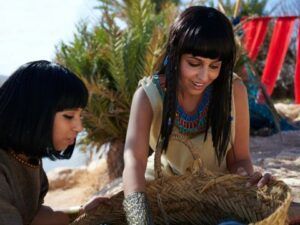
To keep Moses safe his parents hid him from the Egyptian authorities until he was 3 months old and then they placed him in a waterproofed basket in the river to save his life. He was found by Pharaoh’s daughter who decided to take this child, adopt him and raise him herself. (A very interesting detail in this story is that his own birth mother was paid to nurse him.) Exodus 2: 1-9
When Moses grew up he ended up in big trouble when he killed an Egyptian who was beating one of his own people.
Pharaoh heard about it and gave orders for Moses to be arrested and killed. Therefore, Moses fled to Midian to escape the wrath of Pharaoh.
Years passed and the King (Pharaoh) died and the Israelites were still groaning under their slavery and cried out to God for relief.
You can read this story in Exodus 2:1-25
God calls Moses back to Egypt to lead the rescue of his people.
In Midian, Moses had married and was working as a shepherd. He was tending the flock of his father in law when God got his attention and spoke to him from a burning bush.

This is a portion of the conversation:
Then the Lord told him, “I have certainly seen the oppression of my people in Egypt. I have heard their cries of distress because of their harsh slave drivers. Yes, I am aware of their suffering. So I have come down to rescue them from the power of the Egyptians and lead them out of Egypt into their own fertile and spacious land. It is a land flowing with milk and honey—the land where the Canaanites, Hittites, Amorites, Perizzites, Hivites, and Jebusites now live. 9 Look! The cry of the people of Israel has reached me, and I have seen how harshly the Egyptians abuse them. 10 Now go, for I am sending you to Pharaoh. You must lead my people Israel out of Egypt.”
Moses responds with,
who am I to appear before Pharaoh? How can you expect me to lead the Israelites out of Egypt?” Exodus 3:11
The conversation continued until Moses was finally convinced to obey after seeing God do some miracles for him and God told Moses that his brother Aaron could go with him.
God also gave him some more details about the escape including the fact that the king of Egypt would not be willing to let them go without heavy pressure. Exodus 3:12-22
So Moses, along with his brother Aaron went to Pharaoh and as expected, that did not go well. His response was to make the Israelites work even harder.
Pharaoh had to be convinced that for sure and certain, the God of the Israelites was truly behind this plan.
Subsequently, the Egyptian people suffered ten distinct plagues before Pharaoh finally relented.
The plague I want to focus on is the tenth. The final plague, the death of the firstborn- both humans and animals – was the event that directly led to the Exodus after which Pharaoh ordered the Israelites to leave Egypt.
Plague of the death of the firstborn - The Passover Lamb foreshadows the New Covenant
Moses had announced to Pharaoh in Exodus 11:4-8
“This is what the Lord says: At midnight tonight I will pass through the heart of Egypt. 5 All the firstborn sons will die in every family in Egypt, from the oldest son of Pharaoh, who sits on his throne, to the oldest son of his lowliest servant girl who grinds the flour. Even the firstborn of all the livestock will die. 6 Then a loud wail will rise throughout the land of Egypt, a wail like no one has heard before or will ever hear again. 7 But among the Israelites it will be so peaceful that not even a dog will bark. Then you will know that the Lord makes a distinction between the Egyptians and the Israelites. 8 All the officials of Egypt will run to me and fall to the ground before me. ‘Please leave!’ they will beg. ‘Hurry! And take all your followers with you.’ Only then will I go!” Then, burning with anger, Moses left Pharaoh.
How the Israelites escape the 10th plague and their departure from Egypt
While the Israelites were still in the land of Egypt, the Lord gave very specific instructions to Moses and Aaron that would be applicable for the the Israelites to practice for all time going forward. The ceremony that God instituted that day was the Passover Sacrifice to the Lord and it was to be shared with all their descendants. Exodus 12:1-51
They were instructed to roast their meat over a fire and eat it along with bitter salad greens and bread made without yeast. There are more instructions regarding this in the text.
The Israelites were also given specific instructions about how to eat this meal as they would be leaving quickly:
Be fully dressed,[a] wear your sandals, and carry your walking stick in your hand. Eat the meal with urgency, for this is the Lord’s Passover. 12 On that night I will pass through the land of Egypt and strike down every firstborn son and firstborn male animal in the land of Egypt. I will execute judgment against all the gods of Egypt, for I am the Lord! 13 But the blood on your doorposts will serve as a sign, marking the houses where you are staying.
When I see the blood, I will pass over you. This plague of death will not touch you when I strike the land of Egypt.
21 Then Moses called all the elders of Israel together and said to them, “Go, pick out a lamb or young goat for each of your families, and slaughter the Passover animal. 22 Drain the blood into a basin. Then take a bundle of hyssop branches and dip it into the blood. Brush the hyssop across the top and sides of the doorframes of your houses. And no one may go out through the door until morning. 23 For the Lord will pass through the land to strike down the Egyptians. But when he sees the blood on the top and sides of the doorframe, the Lord will pass over your home. He will not permit his death angel to enter your house and strike you down.
29 And that night at midnight, the Lord struck down all the firstborn sons in the land of Egypt, from the firstborn son of Pharaoh, who sat on his throne, to the firstborn son of the prisoner in the dungeon. Even the firstborn of their livestock were killed. 30 Pharaoh and all his officials and all the people of Egypt woke up during the night, and loud wailing was heard throughout the land of Egypt. There was not a single house where someone had not died.
That night, the Israelites left and began their long journey! There is so much more to this story – take the time to read it from start to finish!
The significant point of the 10th plague is the sacrificial lamb and its connection to the New Covenant.
The Covenant to Abraham is expanded
In Exodus 19-24, God reminds the Israelites that He brought them out of slavery and he promises that if they will obey Him and keep His covenant, they will be His own special treasure from among all the nations of the earth; for all the earth belongs to Him. Exodus 19:4-6
The Covenant was further developed with the giving of the Law to Moses at Mount Sinai. There Moses received the Ten Commandments and other laws to govern their society and worship.
Because of their disobedience, lack of faith and sinful acts, the Israelites endured a difficult 40 years wandering in the desert before they finally entered the land that God had promised them.
The significance of the Blood on the Doorpost - How it relates to the New Covenant
The blood on the doorposts at the first Passover event was:
- a sign of substitution in that the innocent, spotless lamb died in place of the household’s firstborn. When God saw the blood, He “passed over” that home because the penalty-death-had already been paid by a substitute.
- the means of protection from judgement- the lamb died instead of the firstborn.
- demonstrating faith and obedience in applying the blood of the sacrificial lamb to their doorposts.
- a mark to show that they belonged to God.
In the New Covenant -Jesus Christ is the Lamb of God whose blood was shed for the sins of the world.
- The substitution of Jesus in our place of punishment. John the Baptist tells us that:
Jesus is the Lamb of God, who takes away the sins of the world. John 1:29
As the lamb in Passover was to be without defect, likewise, Jesus was the sinless Lamb of God.
…for this is my blood, which confirms the covenant between God and his people. It is poured out as a sacrifice to forgive the sins of many. Matthew 26:28
For you know that God paid a ransom to save you from the empty life you inherited from your ancestors. And it was not paid with mere gold or silver, which lose their value. It was the precious blood of Christ, the sinless, spotless Lamb of God.God chose him as your ransom long before the world began, but now in these last days he has been revealed for your sake.1 Peter 1:18-20
- the means of Protection:
In him we have redemption through his blood, the forgiveness of sins, in accordance with the riches of God’s grace. – Ephesians 1:7
a warning: “I tell you, no! But unless you repent, you too will all perish.” – Luke 13:3
“He did not enter by the means of the blood of goats and calves; but he entered the Most Holy Place once for all by his own blood, thus obtaining eternal redemption.” – Hebrews 9:12
- demonstrating faith and obedience
Trusting in Jesus, his blood, which was shed to pay the penalty for our sin, makes a way for us to be right with God. It is the means that will ensure that God’s judgement will “pass over” us when we die.
This means that anyone who belongs to Christ has become a new person. The old life is gone; a new life has begun! 2 Corinthians 5:17
- a mark to show we belong to God: a new transformed life.
“I have been crucified with Christ and I no longer live, but Christ lives in me. The life I now live in the body, I live by faith in the Son of God, who loved me and gave himself for me.” – Galatians 2:20
“Therefore, I urge you, brothers and sisters, in view of God’s mercy, to offer your bodies as a living sacrifice, holy and pleasing to God—this is your true and proper worship.” – Romans 12:1
If you have never asked Jesus to be your Savior, to have your relationship with him in right standing, I urge you to do so.
He offers us forgiveness of sin, the transformation of our heart, new life in Him, the gift of the Holy Spirit to guide us and eternal life with him when our life on earth is over.
In the Further Reading section below, there is a link to a post that will discuss this further.
Author
-
View all posts
I am passionate about strengthening relationships of all kinds. I love to research and write about how we can live in peace, with patience, passion and purpose in our relationships. The most important relationship being with Jesus who died to provide forgiveness of sin for all who will come to Him.

When I see the blood, I will pass over you. This plague of death will not touch you when I strike the land of Egypt.