
Worry has a way of stealing our joy, consuming our thoughts, and leaving us feeling exhausted without actually changing our circumstances. Jesus offers us a better way. In Matthew 6, He reminds us of our Father’s loving care and calls us to trust Him rather than become consumed by the worries of life. What if, instead of allowing worry to dominate our thoughts, we learned to turn those concerns into worship?
The war against worry
I’ve heard a friend say worry is like a rocking chair. It gives you something to do, you’ll go back and forth in your head, but you won’t go anywhere. In my experience, that is so true because all worry did was rob me of joy.
Our final message in Part 1 of our series called TUNED IN: Finding God’s voice in the noise of life, is called worry and worship. Chronic worry is very real, isn’t it? It often feels like we’re embattled in a war against worry.
This past week, I was really busy catching up on a weekend of things I had missed, I was still not feeling 100%, and I was worried I wouldn’t get my message finished in time; but whaddya know God showed up, helped me, reminded me that I didn’t need to worry after all. Despite what we claim to be true, we often need to be reminded that worry is not something God wants us to do.
Maybe you need that reminder today—if so, I hope this message speaks to you in some way and God uses the scattered words and thoughts of a sick pastor to help you out. I said when someone says, don’t worry, it typically means we worry more, but Jesus Himself says that and I think its worth listening to what more He has to say as well in Matthew 6:25-34.
Jesus has something to say about worry
Jesus is preaching to a large following of people throughout this central chapter from his sermon on the mount.
25 “That is why I tell you not to worry about everyday life—whether you have enough food and drink, or enough clothes to wear. Isn’t life more than food, and your body more than clothing? 26 Look at the birds. They don’t plant or harvest or store food in barns, for your heavenly Father feeds them. And aren’t you far more valuable to him than they are? 27 Can all your worries add a single moment to your life? 28 “And why worry about your clothing? Look at the lilies of the field and how they grow. They don’t work or make their clothing, 29 yet Solomon in all his glory was not dressed as beautifully as they are. 30 And if God cares so wonderfully for wildflowers that are here today and thrown into the fire tomorrow, he will certainly care for you. Why do you have so little faith?
31 “So don’t worry about these things, saying, ‘What will we eat? What will we drink? What will we wear?’ 32 These things dominate the thoughts of unbelievers, but your heavenly Father already knows all your needs. 33 Seek the Kingdom of God[a] above all else, and live righteously, and he will give you everything you need.
34 “So don’t worry about tomorrow, for tomorrow will bring its own worries. Today’s trouble is enough for today.
Worry. Fretting. Anxiety. The end of this chapter challenges us in very real, very relevant ways when it comes to fretting and faith.
Does worry actually accomplish anything?
In Verses 25-30 Jesus prompts us to reflect on a question.
What if we intentionally replaced perpetual worry with consoling trust in God?
What if we replaced worry with faith and trust, uncompromised and unaltered by the burdens of earth?
We fret and worry all the time about things, things like our health, relationships, finances, futures, work and worth. And many aspects of these common worries are outside of our control. Yet we end up fretting about them as if we could change them.
Jesus’ point, according to Matthew in Chapter 6, is that this kind of anxiety – about things we cannot control – is never worth the mental and physical toll it often takes on us. It’s why Jesus asks the question in verse 27:
“which of you, by worrying, can add a single hour to his life?”
Great Question!
Let me pause and pose that to you:
In seasons of intense and persistent worry, what benefit did the anxiety or worry produce?
Did your worry directly lead to making things better?
An exasperated husband asked his wife who was in a panic once, “Why are you always worrying when it doesn’t do any good?” She quickly piped back, “Oh yes it does! Ninety percent of the things I worry about never happen.” In fact, I was looking online and Cornell University did a study that showed that 85% of what people worry about never actually comes to pass.
I think I can safely surmise that without question, worry does not provide any advantage. It does not increase your life nor bring comfort or peace. Truly, it doesn’t help you focus or provide a benefit of any kind to you. In fact, it does the opposite and makes us fixated on things that Jesus knows don’t help.
Instead, Jesus reminds us that in those seasons of worry, “trust in me and that is enough.” That is what you need, that is all you need. And that’s the point Jesus is making specifically in verses 25-33, especially here in verse 26.
Trusting God doesn't mean being careless
Now, don’t go letting yourself off the hook entirely. Jesus is not excusing our role in managing the affairs of our lives. Right? Jesus is not excusing carelessness with our finances or relationships, He’s not excusing laziness or unhealthy self-indulgence when it comes to taking care of yourself. After all, to take the analogy back to birds in Matthew 6, birds themselves don’t just wait with mouths wide open for God to drop food into their beaks. They have to scour and hunt for it. Jesus isn’t saying “go ahead and do whatever you want and I’ll take care of everything.” The point is NOT that Jesus’ disciples shouldn’t work but that they shouldn’t worry while they work.
Look at creation, God is faithful
Look around at His creation. God has created soil for the flowers, given rain for them to grow, seasons to bring a cycle of new life. Similarly, He gives the birds beaks to hunt for food, claws to create a nest and a home for themselves, feathers to protect them from storms and frigid temperatures. All of this shows His care for the natural world He brought into being. In Matthew 6, Jesus is commanding us to see how God’s providence is so rich, His grace so wide, His care so deep that He has provided for all of creation.
And with that fresh in our mind, Verse 30 offers this often sobering thought: if that is how God cares for the lesser things of this world, “how much more will He clothe you,” protect you, care for you?
Where then, is our trust and faith in His love and concern for us when we can visibly, tangibly see with our own eyes His merciful activity and marks of His love etched into all of creation? And just how much greater is God’s love and concern for us, then? How can we measure that? How can we see that? Well Jesus is how much greater, Jesus is that measure of his love and concern. Christ died so that we can have true life. Christ died to buy us out of slavery to our sinfulness and the dark pit of despair and sorrow that we are trapped in. He saves us from that. That’s how much he cares for us, for you.
1 Peter 5:7 ties really well into this section in Matthew. It says “Cast your cares on Jesus, because He cares for you.” His care runs so deep that He wants you to be relived of those anxieties and those repeating worries that plague your mind, day in and day out. We can trust in Jesus’ words in Matthew 6 because He loved us so greatly that He died for us.
Jesus didn’t die for the birds or the flowers which He made and tends to. But He died for you and me. God cares so much for us that His one and only Son suffered horribly and died a terrible death so that we can be free.
That’s the measure of God’s love for us. And even that doesn’t describe it well enough.
The greatest evidence of God's care
So today, what daily life concerns tempt you to feel anxious or to worry right now? Cast those anxieties onto Jesus and learn to trust Him unequivocally because He has shown how much He cares for and loves you.
Matthew 6:31-34 concludes this portion of Jesus’ teaching. In it He says:
“So don’t worry about things, saying, ‘What will we eat? What will we drink? What will we wear?’ These things dominate the thoughts of unbelievers, but your heavenly Father already knows all your needs. Seek the Kingdom of God above all else, and live righteously, and He will give you everything you need. So don’t worry about tomorrow, for tomorrow will bring its own worries. Today’s trouble is enough for today.”
In these final lines, Jesus clarifies that the more we prioritize pursuits of earthly things over Jesus, even our physical well-being, the more we will worry. There will always be earthly things to worry about, especially if we make them a priority over Jesus. And if we do that, we’ll only grow to be more anxious and less trusting. Which doesn’t really sound like growth, does it? The answer to our worries about life’s problems isn’t to spend more time on them or focus on them more, but less, replacing that focus with a commitment and devotion to Jesus and the Kingdom of God. That’s how the war against worry is won. Through Jesus. Always.
Church, if there’s one thing Jesus wants you to understand from this passage, it’s that Worry is never worth it. Worry isn’t worth our time or our energy. Because the more time and energy we give to worry, risks making idols of the things we’re worried about. Earlier, I referenced 1 Peter 5:7 and I want to return to it.
What is weighing on your heart today?
The apostle Peter encourages readers to “cast our anxieties (that means our troubles, worries, anxieties) on Him because He cares for you.”
Cast your burdens. I find this such an interesting choice of word here. What do you think of when you hear the word casting?
I think of fishing when I hear the word casting. Casting implies not just laying down your worries but literally throwing them away from you, putting great distance between yourself and them and that can take a lot of effort. It can involve a great deal of focus and work to cast properly, in such a way that we no longer have those worries on our shoulders. But when we cast our anxieties away onto Jesus, the experience is far better than any temporary relief the world can offer.
And in every moment when you are wracked with worry, I want to encourage you to take every opportunity to turn your worry into worship.
The reality is that we can allow worry to dominate our thoughts, or we can intentionally turn our attention toward worship. We may not be able to prevent anxious thoughts from coming, but we can choose where we direct our attention and where we place our trust.
From fear to faith: learning from David
We can’t do both simultaneously. In many of the Psalms written by David, there is a pattern that emerges, when you study them.
For example, let’s take a look at Psalm 56:1-4. David writes;
Be merciful to me, my God, for my enemies are in hot pursuit; all day long they press their attack. My adversaries pursue me all day long; in their pride many are attacking me. When I am afraid, I put my trust in you. In God, whose word I praise—in God I trust and am not afraid. What can mere mortals do to me?”
Most of David’s psalms follow a similar template to this: they begin with addressing God, then explain the struggle or worry (which often use metaphors to put it into words to help better relay the anxiety or worry) and then the resolution pivots toward God’s character, faithfulness, and promises.
Notice how this Psalm begins with an address “my God”. Then, see how it transitions from worry in verses 1-2 to worship in verses 3-4. This is a pattern that repeats in this same psalm over and over again, until the end. You’ll see it elsewhere, too.
But it challenges us to take our worries to God, submit our concerns to Him, and then be intentional about turning them from anxious worries into trustful praises.
Becoming a Psalmist: Write your own Psalm
If you’d like to practice turning worry into worship, as David does in his psalms, here’s a little exercise I want to encourage you to try. You’re going to become a Psalmist today! You’re going to pen your own psalm. To do this, we’ll use verses 1-4 of Psalm 56 as a template.
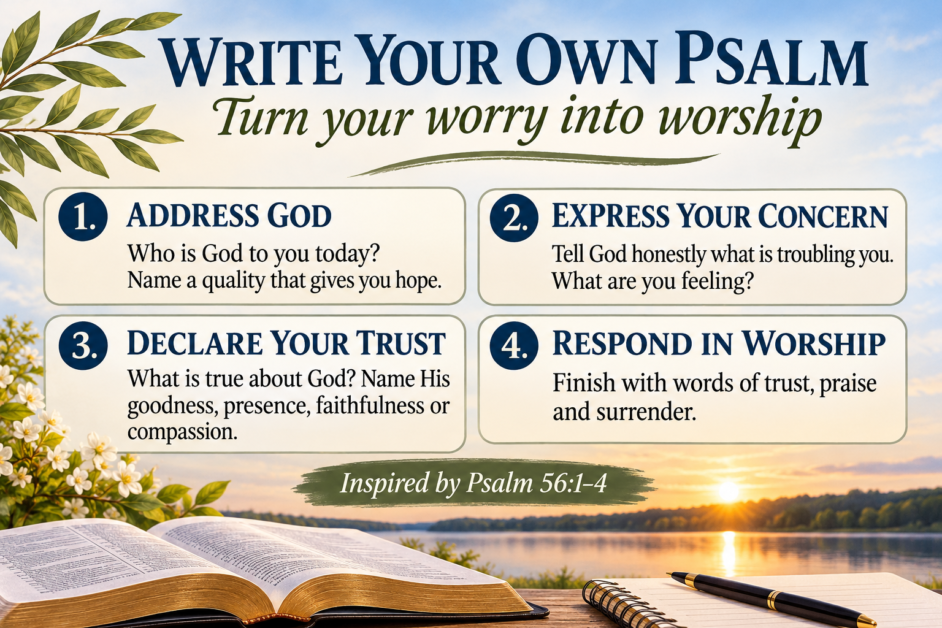
So try writing your own Psalm to God. Write out these words taken from Psalm 56. Start with addressing God in His role as Father or Son or Provider or Saviour, etc. Then write out the characteristics or qualities of our amazing God that are particularly meaningful to you in this moment.
Some of the Psalms use phrases like “Oh God, my Shield, my sword” or “Oh God my refuge from the storm” or you could use something like “Christ, my one and only king”. Find a characteristic of two of God that brings you peace in this moment of struggle and trial and address God using those words.
Be honest about your struggles
Then after you’ve addressed God, express your concern. Following Psalm 56 again, “Be merciful and faithful to me, God, for STATE YOUR WORRY OR ANXIETY and how it makes you feel. Use a metaphor to express it, as David does, if you’d like. Pick an everyday object, a part of nature, or a human experience to describe or picture what you’re feeling.
Something like “I feel like a leaf caught in the winds of a hurricane, tossed and turned and thrown about, beaten, tattered, suffocating under its pressure. Again, it does not need to have that kind of imagery, but if it helps better express what you’re feeling, then go for it.
Refocus your heart on God’s goodness
Then we come to the conclusion, here, the most important part— the part that helps us reaffirm our uncompromised trust and Kingdom-focused priority. The final lines, inspired again by Psalm 56. “When I am INSERT ONE OR TWO WORDS RECAPPING HOW YOU FEEL (afraid, worried, defeated)
Then, “I trust in and seek You, my God, for you are STATE WHAT IS GOOD ABOUT GOD. His sovereignty, His presence, His compassion, His grace. Name as many as you like. The goal of this is to turn our attention and our sight toward the goodness, righteousness, and hope of Jesus, where our faith finds legs to stand.
And finally to quote Matthew 6:33-34, we will finish with this statement. “I choose to worship you, seek you, and trust you with all my heart. I will not worry about what tomorrow brings but trust that you are more than enough for today.
Turning worry into worship; Putting it into practice
This is what it will look like, minus the blanks. Now, this is just one way we can turn our worry into worship, its not an exhaustive approach, but it may help you cast your thoughts to the things of Jesus. I don’t want to pretend that just writing down words is all it takes to transform the worry in your life but a big part of removing that worry begins with focusing on the One person who can take it away and less on the things that don’t help. It’s about giving worry and anxiety less of a voice and letting our holy and righteous God replace that worry with peace and life.
Don't let worry win the war for your heart
“Worry is fear extravagance. It extracts interest on trouble before it comes due. It constantly drains the energy God gives us to face daily problems and to fulfill our many responsibilities. It is therefore a sinful waste.”
Let the words of Matthew 6:25-34 and 1 Peter 5:7 permeate our hearts and minds today so that when we are tempted to worry or we are threatened with great anxiety, we know who to turn to, trust in, focus on, and worship whole-heartedly.
Because Worry isn’t worth it; don’t let worry win the war for your heart—let Christ in and let God win it for you!
