And He said to all, “If anyone would come after me, let him deny himself and “take up his cross daily and follow me. For ”whoever would save his life will lose it, but whoever loses his for my sake will save it. Luke 9:23-24 (ESV)
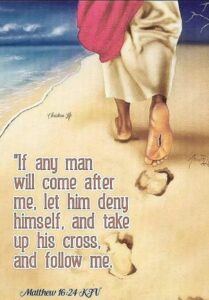
The message of these verses becomes even richer when we look at what Jesus says immediately before them.
Jesus has just asked His disciples, “Who do you say that I am?” Peter answers, “The Christ (Messiah) of God” (Luke9:20). Then Jesus immediately begins explaining that the Messiah must suffer, be rejected, killed, and raised. In other words, Jesus defines Messiahship through the cross before He defines discipleship through the cross. That is important.
Jesus said “Deny Yourself”
Jesus doesn’t say,” Deny yourself and then I will accept you.” The order matters. His disciples are responding to who He already is and what He is about to accomplish.
 To deny yourself is to dethrone yourself. It’s saying, “My life is no longer ultimately about protecting my interests, controlling my future, getting my way, or building my identity. Christ is Lord.”
And that can be surprisingly subtle. Self-denial isn’t merely giving up something obviously sinful. Sometimes it means surrendering something perfectly legitimate because we have made it ultimate – our comfort, reputation, security, plans, or even our desire to understand everything God is doing.
“Take up your cross daily”
The cross wasn’t merely a symbol of inconvenience. To Jesus’ original audience, the cross represented death to one’s former claim to self-rule.
It there’s an important distinction: Jesus is not telling us to accomplish what He accomplished. His cross is unique. He alone bore our sin and accomplished redemption. Our cross is the consequence of belonging to Him and following His way.
That’s where I think this connects beautifully with the idea of the finished work of Christ. We don’t carry our cross to complete Christ’s work. We carry it because Christ’s work has already changed whose we are.
Paul captures something similar in Galatians 2:20:”I have been crucified with Christ and I no longer live, but Christ lives in me.” The Christian life isn’t primarily “try harder to become a better Christian,” It’s increasingly learning to live from the new identity and new life God has already given us in Christ.
“Whoever loses his life will save it”
This is the great paradox.
We naturally think, “If I give up control, I’ll lose myself.”
Jesus says the opposite: The attempt to preserve the self on its own terms is precisely what causes us to lose the life God intended for us.
Think about it this way:
- “If I have to be in control, I will never experience the freedom of trusting God.
- “If I have to protect my reputation, I will never experience the freedom of simply being known by God.”
- or “If I have to get my way, I will never experience the freedom of surrender.”
- and If my life has to revolve around me, I will never discover what it means for Christ to become the centre.”
So Jesus isn’t saying,”Stop enjoying life.”He’s saying, “Stop trying to be your own source of life.”
And that is a profound difference.
There is also a beautiful connection to grace.
I think this passage can sometimes be preached in a way that leaves people feeling that Christianity is essentially “give up more, sacrifice more, try harder.” But that can miss the heart of the Gospel.
Jesus isn’t saying: Lose your life so that you can become worthy of me.
He’s saying, in effect: Give me the life you are trying so hard to hold onto and discover that I am the one who can actually give you life.
The cross is therefore not merely a demand- it is also an invitation to freedom.
And perhaps the deepest question of Luke 9:23-24 isn’t,
“What am I willing to give up for Jesus?”
It is:
“Am I willing to trust Jesus enough to let Him have ownership of my life?”
That’s a much deeper question. And I think it gets very close to what Jesus means when He says that the person who loses his life for His sake will save it.
Ultimately, we don’t lose ourselves at the cross. We lose the false self that insists on being its own lord- and discover our true life in Christ.
Good News Only! OUR GOD IS A BIG GOD!
Blessings Gerry


